
The world of smartphones is constantly evolving, and one of the biggest changes in recent years has been the arrival of 5G. It’s a term you’ve probably heard a lot, from phone commercials to news headlines. But what does it really mean for you and your daily phone use? This article will dive deep into everything about 5G smartphones, from the core technology that makes it work to what you should look for when buying your next device, all explained in simple, casual English.
What is 5G, Anyway? The Big Picture
Before we talk about the phones themselves, let’s get the basics of 5G straight. Think of 5G as the next big upgrade for our mobile networks, a generational leap just like when we went from 3G to 4G. The “G” stands for “generation.” Each new generation has brought faster speeds and better reliability, and 5G is no different, but it’s a much more significant jump than the last one.
While 4G was a game-changer for things like streaming video and social media on the go, 5G is designed to do much more. It’s built to handle a massive number of connected devices at once, which is crucial for the future of technology like smart homes, self-driving cars, and the internet of Things (IoT). For you, the smartphone user, this means not only faster downloads and smoother streaming but also a network that’s less likely to get bogged down when everyone is trying to use it at the same time.
The Three Flavors of 5G: Low, Mid, and High-Band
You might think 5G is just one thing, but it’s actually a combination of different radio frequencies, or “bands,” that all work together. This is a key reason why your 5G experience can vary so much depending on where you are and what phone you have. Let’s break down the three main types of 5G bands:
So, when you see a phone advertised with 5G, remember that it’s crucial to understand which of these bands it supports. A phone that only works on low-band won’t give you the same blazing-fast speeds as one that can also tap into mid-band and high-band networks.
What Makes a Smartphone a “5G Smartphone”?
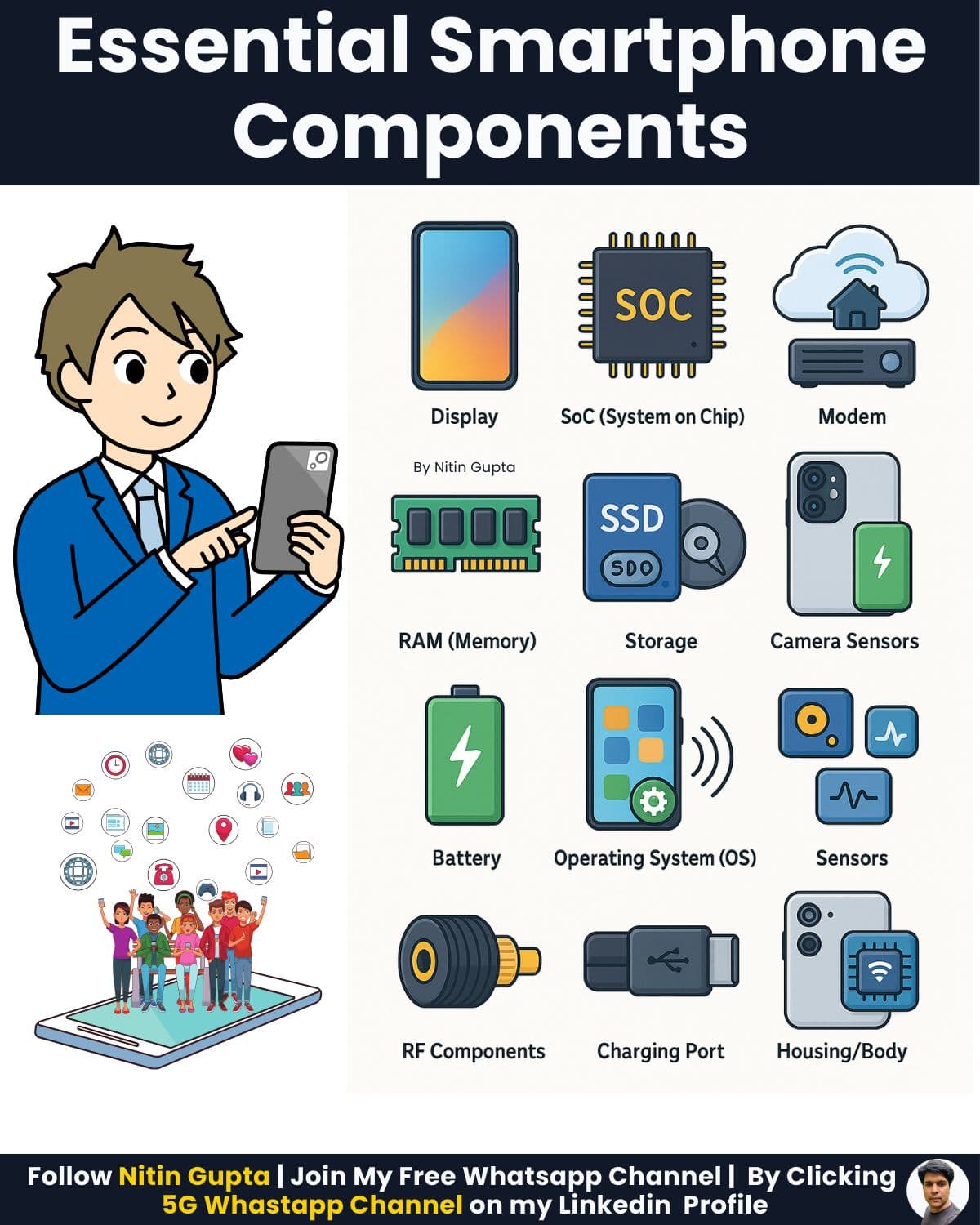
It’s not just about flipping a switch. For a smartphone to be 5G-capable, it needs specific internal hardware. This includes a 5G modem and antenna system that can receive and process those high-frequency 5G signals.
Why Should You Care About a 5G Smartphone? The Practical Benefits
Beyond the tech talk, what does a 5G smartphone actually do for you? The benefits are both immediate and long-term.
1. Speed, Speed, and More Speed: This is the most obvious and talked-about advantage. Downloading apps, music, or movies will be significantly faster, especially on mid-band and high-band networks. You’ll spend less time waiting and more time doing.
2. Lower Latency: Latency is the delay between when you send a request and when the network responds. Think of it as the time it takes for a message to travel from your phone to the network and back. On 4G, latency is around 50-100 milliseconds. On 5G, it can drop to as low as a single millisecond. This isn’t just a number; it has real-world implications.
3. Increased Capacity: With more devices connected than ever before, networks can get congested, slowing everyone down. 5G is designed to handle this massive increase in traffic without breaking a sweat. So, when you’re at a crowded concert or a big sporting event, your 5G phone will still be able to connect and perform well, while those on 4G might struggle to even load a webpage.
4. Better Battery Life (Eventually): This one might sound counterintuitive, as early 5G phones were known for having worse battery life. However, the technology is improving rapidly. Because 5G is so much more efficient, a phone can download what it needs to and then go back to a low-power state faster, which can ultimately lead to better battery performance over time. As chipsets become more optimized for 5G, this will become an even more significant benefit.
The Current Landscape: What to Look For When Buying
Now that you know the basics, here’s a quick guide to what you should consider when you’re in the market for a new 5G smartphone.
1. Check for All Three Bands: Don’t just settle for a phone that says “5G.” Do a little research to make sure it supports low-band, mid-band, and high-band (mmWave) networks. A phone that supports all three is considered “full-band 5G” and will be the most future-proof and versatile.
2. Carrier Compatibility: Not all phones work on all carriers, and this is especially true for 5G. Make sure the phone you’re buying is compatible with your specific mobile carrier and that your carrier’s 5G network is available in your area. You don’t want to buy a 5G phone only to find out you’re in a 4G-only zone.
3. Battery and Processor: 5G, especially high-band 5G, can be a bit of a power hog. Look for a phone with a large battery and a modern, efficient processor that is designed to handle the demands of 5G connectivity without draining your power too quickly.
4. Price Point: The good news is that 5G is no longer just a premium feature. You can now find excellent 5G smartphones at a variety of price points, from entry-level devices to high-end flagships. This makes the technology accessible to a much wider audience.
The Future is 5G-Enabled
The 5G smartphone is more than just a faster phone. It’s the key to a more connected, efficient, and technologically advanced world. From seamless entertainment and communication to groundbreaking innovations in transportation and medicine, the possibilities are vast. Understanding what 5G really is—and what to look for in a 5G smartphone—empowers you to make the right choice for your needs and ensures you’re ready for the exciting digital future that’s already here.


